

Overview
A knee that suddenly locks, refusing to fully straighten or bend for a moment, is one of those symptoms that’s alarming precisely because it seems to happen without warning. Unlike general achiness, locking usually points to something mechanical happening inside the joint, most commonly a torn piece of meniscus or cartilage getting caught between the bones. Getting this evaluated through Knee Arthroscopy in Rohini early on typically means a simpler fix than waiting until the locking becomes frequent or the joint sustains further damage.
Dr. Kunal Aneja, practising at Naveda Healthcare Centre in Rohini and Saroj Medical Institute, evaluates knee locking through imaging before determining whether arthroscopic treatment is genuinely necessary.
Why the Knee Actually Locks
What’s usually happening mechanically:
● A torn piece of meniscus can flip and become trapped between the bones of the joint
● Loose cartilage fragments can similarly catch and block full movement momentarily
● The locking sensation is mechanical, not just pain-related, which is why it feels so distinct
● Repeated locking can cause further damage to the joint surface over time if left untreated
True mechanical locking, where the knee physically catches rather than just hurting, is a specific signal that something structural needs to be addressed.
Meet Dr. Kunal Aneja – Knee Arthroscopy Surgeon in Rohini
Patients experiencing knee locking want a surgeon who can accurately distinguish mechanical locking from general stiffness or pain.
Professional Highlights:
● Extensive training in arthroscopic, minimally invasive knee surgery
● Fellowships from Delhi Orthopaedic Association, SICOT, and Asia Pacific Arthroplasty Society
● Over 12 years of experience across sports medicine and joint disorders
● Practising at Naveda Healthcare Centre, Rohini, and Saroj Medical Institute, Rohini
Patients can describe their specific knee symptoms directly via WhatsApp before booking a consultation.
What Causes Knee Locking
1. Meniscus Tears
The most common cause, where a torn flap of cartilage catches between the joint surfaces.
2. Loose Bodies
Fragments of bone or cartilage floating within the joint that can temporarily block movement.
3. Ligament Instability
In some cases, ligament laxity contributes to abnormal joint movement that mimics locking.
4. Cartilage Damage
Advanced wear or damage to the joint surface can occasionally cause a similar catching sensation.
Why Choose Dr. Kunal Aneja for Knee Arthroscopy in Rohini?
Key advantages:
● Arthroscopic, minimally invasive technique for accurate diagnosis and repair
● Practice based directly in Rohini for local accessibility
● Extensive sports medicine experience treating meniscus and ligament injuries
● Structured rehabilitation support built into every treatment plan
A surgeon experienced specifically in arthroscopic meniscus repair offers a meaningfully less invasive path to resolving true knee locking.
Signs Your Knee Locking Needs Evaluation
Consider a consultation if:
● Your knee has caught or locked, even briefly, more than once
● You’ve noticed swelling alongside the locking episodes
● The knee feels unstable or gives way in addition to locking
● Locking is accompanied by a specific popping sensation during the initial injury
Any true mechanical locking, even if it resolves on its own within seconds, is worth evaluating rather than waiting for it to happen again.
Step-by-Step Knee Evaluation and Treatment
1. Initial Consultation
Symptoms, injury history, and locking pattern are assessed in detail.
2. Imaging Review
MRI typically confirms whether a meniscus tear, loose body, or other issue is present.
3. Treatment Decision
Arthroscopic surgery or conservative treatment is recommended based on findings.
4. Arthroscopic Procedure
If needed, the torn or loose tissue is repaired or removed through small incisions.
5. Structured Rehabilitation
A recovery plan restores strength and full, catch-free movement over time.
Benefits of Arthroscopic Knee Treatment
✔ Directly addresses the mechanical cause of locking, not just the symptom
✔ Minimally invasive technique with smaller incisions and less scarring
✔ Faster recovery compared to traditional open knee surgery
✔ Prevents further joint damage from repeated locking episodes
✔ Structured rehabilitation supporting full return to activity
Addressing the actual mechanical cause of locking through arthroscopy prevents the repeated joint damage that untreated locking can cause over time.
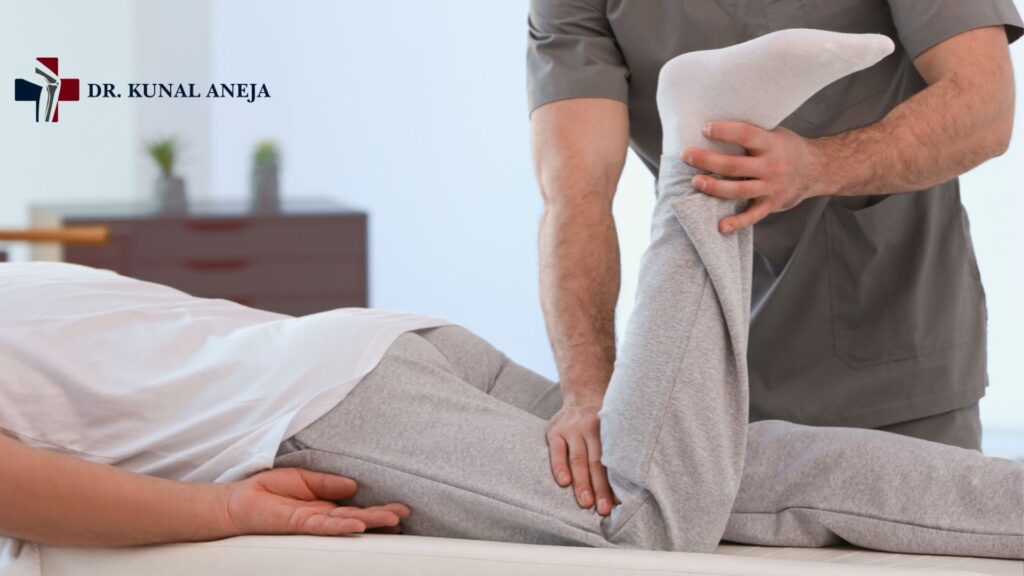
Recovery After Knee Arthroscopy
What recovery typically involves:
● Initial rest and gradual weight-bearing in the first few days
● Physiotherapy to restore range of motion and strength
● Progressive return to normal activity over several weeks
● Full recovery timeline depending on the specific repair performed
Most patients notice the locking sensation resolve immediately after treatment, with strength and full range of motion returning through structured physiotherapy.
Why Rohini Patients Trust Dr. Kunal Aneja for Knee Arthroscopy
● Practice based directly in Rohini at Naveda Healthcare Centre and Saroj Medical Institute
● Extensive fellowship training in arthroscopic knee surgery
● Accurate diagnosis distinguishing true locking from general knee pain
● Direct WhatsApp access at api.whatsapp.com/send/?phone=919811211503 for questions
● A track record built on thousands of successful orthopaedic procedures
Getting true knee locking evaluated early, rather than waiting for it to become frequent, is what usually keeps treatment simple and recovery straightforward.
Conclusion
A knee that suddenly locks is a genuine mechanical signal, usually pointing toward a meniscus tear or loose fragment inside the joint, not something to dismiss as ordinary stiffness. Dr. Kunal Aneja evaluates this pattern carefully at his Rohini-based practice, using arthroscopic technique to resolve it with minimal downtime.
For questions about knee locking, email drkunalaneja@gmail.com or call (+91) 98112 11503. Follow patient outcomes on Instagram and Facebook.
Book your knee consultation with Dr. Kunal Aneja here.
FAQs
Why does my knee suddenly lock up sometimes?
This is usually caused by a torn piece of meniscus or a loose cartilage fragment getting caught between the joint surfaces during movement.
Is knee locking a medical emergency?
It’s not typically an emergency, but true mechanical locking should be evaluated promptly, since repeated episodes can cause further joint damage over time.
Does knee locking always require surgery?
Not always. Some cases respond to conservative treatment, though a torn meniscus causing true locking often needs arthroscopic repair to fully resolve.
How is knee locking different from general knee stiffness?
Locking involves the knee physically catching or being unable to move at a specific point, while stiffness is a general restriction in movement without that catching sensation.
How long does recovery take after knee arthroscopy for locking?
Most patients notice the locking resolve immediately after treatment, with full strength and range of motion typically returning within several weeks of physiotherapy.