

Robotic Knee Replacement Surgery in Delhi: Who Is Actually a Good Candidate
Overview
You’ve probably come across robotic knee replacement described as the newest and best option available, which raises an obvious question that most articles skip over: is it actually the right option for you specifically, or just the most heavily marketed one. The honest answer is that robotic assistance benefits many but not all patients equally, and this piece explains where that line actually falls in practice.
What Robotic Assistance Actually Changes During Surgery
Robotic-assisted knee replacement combines the surgeon’s judgment and skill with computer-guided precision for implant positioning. It doesn’t replace the surgeon’s decision-making; it refines the accuracy of execution, particularly around alignment and fit, which are two of the biggest factors in long-term implant performance and comfort.
Why Alignment Precision Matters So Much
Small deviations in implant alignment during traditional surgery can lead to uneven wear, discomfort, or a shorter functional lifespan for the joint. Robotic guidance allows for more consistent precision in this area, which is part of why it’s associated with strong long-term outcomes in appropriate candidates who genuinely benefit from that extra layer of accuracy during the procedure.
Who Tends to Benefit Most
Patients with more complex anatomical considerations, previous injuries affecting joint alignment, or significant deformity from long-term arthritis often see the clearest benefit from robotic assistance, since these are exactly the situations where precise, personalized alignment matters most for a durable, long-lasting outcome.
Where Robotic Assistance Matters Less
Not every knee replacement case requires this level of technology. Straightforward cases with normal anatomy and minimal deformity may achieve excellent outcomes with either approach, and this is a conversation worth having directly during consultation rather than assuming the more advanced-sounding option is automatically better for your specific case and anatomy.
What the Assessment Process Looks Like
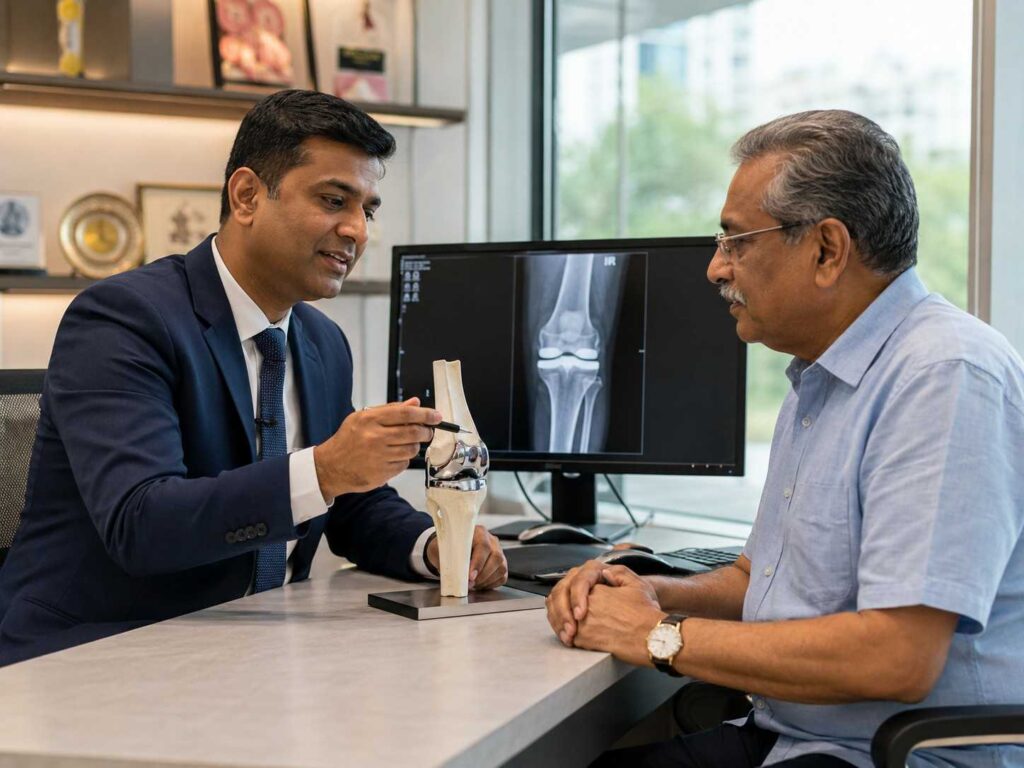
Determining candidacy typically involves imaging to assess joint alignment, deformity, and bone quality. Dr. Kunal Aneja’s approach to robotic knee replacement starts with this kind of detailed assessment before recommending whether the robotic approach adds meaningful value for your specific joint and lifestyle needs.
Recovery Expectations With Robotic-Assisted Surgery
Recovery timelines are broadly similar to traditional knee replacement, though many patients report somewhat less post-operative discomfort due to the precision of soft tissue handling during the procedure. Most patients begin walking with assistance within a day or two and resume routine activities over the following weeks, following a structured, progressively advancing recovery plan.
Cost Considerations Worth Understanding Upfront
Robotic-assisted procedures typically carry a higher cost than traditional knee replacement, reflecting the additional technology and preparation involved. Understanding whether that added cost is justified for your specific anatomical situation is part of what a proper consultation should clarify, rather than leaving as an afterthought discovered only at billing time.
How Long-Term Joint Longevity Factors Into the Decision
For younger, more active patients expecting decades of use from their new joint, the precision benefits of robotic assistance can matter more over the long run than for older patients with more modest activity expectations. This is worth weighing honestly during the decision process rather than treating age as irrelevant to the choice.
Questions Worth Asking Before Committing to the Robotic Approach
For a deeper look at the reasoning behind these decisions, Dr Kunal Aneja’s approach to robotic knee replacement is covered in more detail in a separate guide.
It’s reasonable to ask how many robotic-assisted procedures your surgeon has performed, what specifically about your anatomy makes it a good fit, and what the realistic difference in outcome would be compared to a traditional approach for your particular case and goals.
Conclusion
Robotic knee replacement surgery in Delhi offers genuine precision benefits, particularly for patients with complex alignment needs, but it isn’t automatically the right choice for every case. A thorough assessment of your specific joint anatomy is what actually determines whether the technology adds meaningful value for you.
Frequently Asked Questions
Is robotic knee replacement better than traditional surgery for everyone?
Not necessarily. It offers clear precision advantages in complex cases, but straightforward cases can achieve excellent outcomes with either approach.
Does robotic surgery mean the robot performs the operation?
No. The surgeon performs the procedure throughout, with the robotic system providing guidance and precision for implant positioning.
How do I know if I’m a good candidate for the robotic approach?
This is determined through imaging and assessment of your specific joint alignment, deformity, and overall anatomy during consultation.
Is recovery faster with robotic knee replacement?
Recovery timelines are broadly similar to traditional surgery, though some patients report reduced discomfort due to more precise tissue handling.
CTA