
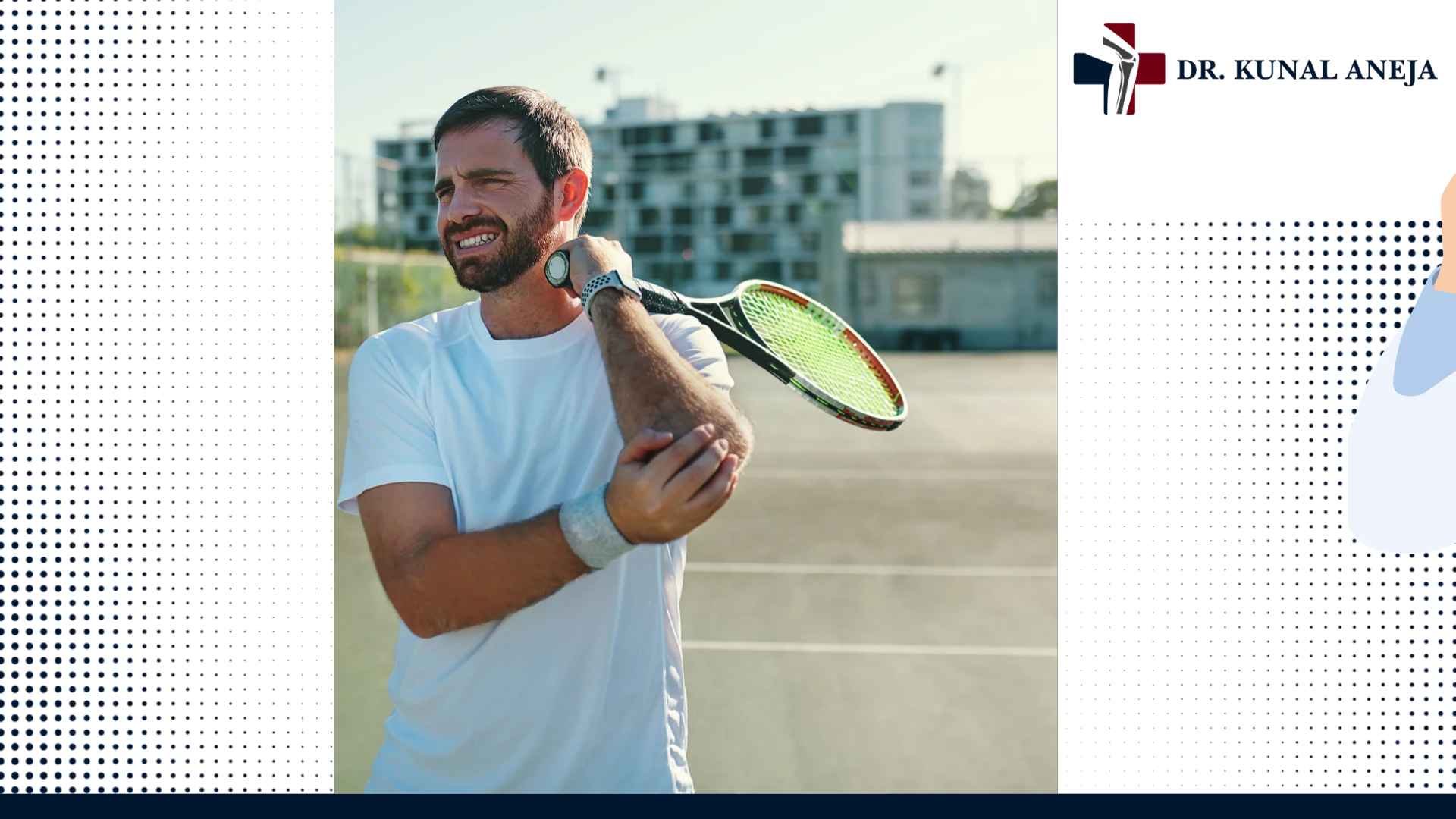
Tennis elbow treatment usually starts without surgery: rest from the aggravating activity, guided exercises, sometimes a brace, and time. Most people improve with these steps, though recovery can be slow. Surgery is considered only for stubborn cases that haven’t responded to proper non-surgical care for many months. The medical name is lateral epicondylitis, and you don’t need to play tennis to get it. An orthopaedic doctor can confirm the diagnosis and rule out other causes of elbow pain. You can book an appointment here.
Overview
Picture an office worker who’s been typing and clicking all week (a hypothetical, but a very familiar one). On Saturday she lifts a kettle and feels a sharp, burning ache on the outside of her elbow. By Monday, even picking up her coffee mug hurts. She’s never held a tennis racket in her life.
That’s the thing about tennis elbow. The name misleads people into thinking it’s a sportsperson’s problem. In reality, it shows up in painters, plumbers, cooks, desk workers, gardeners and anyone who grips, twists and repeats the same wrist movement for long enough.
The good news is that it’s rarely dangerous. The less good news is that it can hang around, and many people make it worse by resting completely for a week, going back to full activity and flaring it up again.
This guide explains what tennis elbow is, how to recognise it, what treatment looks like, which exercises are used, what the evidence says about braces and injections, and when surgery makes sense. This is general information, and your own plan should follow an examination. The clinic’s site also has a list of treatments offered and a blog on elbow arthroscopy.
What Is Tennis Elbow?
In plain words
● Pain on the outer side of the elbow, where the forearm muscles that lift the wrist attach to the bone
● Caused by repeated strain on those tendons
● Doctors call it lateral epicondylitis
● Pain often shows up with gripping, lifting or twisting
● Usually settles with time and the right care, though it can take months
Think of it as an overuse injury of the tendon attachment, not a joint problem.
Meet Dr. Kunal Aneja
Dr. Kunal Aneja is a Senior Consultant Orthopaedic Surgeon and Managing Director of Naveda Healthcare Centre, Delhi, with interests in joint replacement, sports medicine, joint preservation and complex trauma. His listed qualifications include MBBS, MS, DNB, M.Ch (Edinburgh) and a Diploma in Football Medicine (FIFA). He consults at Naveda Healthcare Centre, Max Super Specialty Hospital, Shalimar Bagh and Saroj Medical Institute, Rohini.
Professional Highlights
● Elbow arthroscopy is covered on the clinic’s blog
● Sports medicine background
● Physiotherapy and rehabilitation information on the site
● Clinic at 57 & 61, Pocket D-15, Sector-7, Rohini, Delhi
Have an elbow problem that’s not settling? WhatsApp your question and any reports to the clinic.
Tennis Elbow Symptoms: What to Look For
Tennis elbow symptoms build up slowly in most people. Common ones include:
● Pain or burning on the outside of the elbow
● Pain that travels down the forearm toward the wrist
● A weak grip, so you drop cups or struggle to hold a bag
● Pain when shaking hands or opening a jar
● Pain when lifting something with the palm facing down
● Tenderness when you press the bony bump on the outer elbow
Tennis elbow pain usually stays on the outside of the elbow. If your pain is on the inside, that’s a different problem, often called golfer’s elbow.
Get checked soon if
● You had a fall or sudden injury and the elbow is swollen or deformed
● The elbow is locked or can’t fully straighten
● You have numbness or tingling in the hand or fingers
● The pain is severe at rest or at night
● Symptoms haven’t improved after several weeks of sensible care
Why Does It Happen?
Tennis elbow develops when the tendons around the outer elbow are overloaded again and again. A few common triggers:
● Repetitive gripping or wrist movements at work, such as typing, painting, using tools or chopping
● Sports with racket or bat grips, throwing or weightlifting
● A sudden increase in activity after a break
● Poor technique, like a loose or badly fitted racket grip, or a wrist-heavy backhand
A 2007 review in American Family Physician reports that it affects around 1 to 3 percent of people each year, usually from age 40. Tennis players get it, but so does everyone else.
How Is It Diagnosed?
Most of the time, a doctor can diagnose tennis elbow by listening to your story and examining the elbow. Pressing on the outer elbow, and resisting wrist or finger extension, usually reproduces the pain. X-rays are not always needed, but a doctor may order them or an MRI or ultrasound if the picture isn’t clear, or if another problem is suspected.
It’s worth getting it checked because other things can feel similar:
● A pinched nerve in the neck or around the elbow
● Arthritis of the elbow joint
● Radial tunnel problems
Tennis Elbow Treatment: What Usually Works
Here’s the honest bit. The 2007 AAFP review notes that, untreated, symptoms last on average 6 to 24 months, and that “watchful waiting” is a reasonable option. In one trial it did about as well as physical therapy at one year. That’s not a reason to ignore the pain. It’s a reason to be patient and pick the safe, boring options first.
1. Activity Changes
You don’t need to stop everything. You do need to stop what provokes it, at least for a while:
● Cut down repetitive gripping and heavy lifting
● Use both hands for heavy objects, with the palm facing up
● Take breaks during keyboard and mouse work
● Fix your workstation. The clinic’s page on ergonomics can help
2. Pain Relief
Short courses of pain relief, ice and topical anti-inflammatory gels are commonly used. The AAFP review says topical anti-inflammatory medicine has good evidence for short-term pain relief, while oral anti-inflammatories show mixed results. Don’t take painkillers for long periods without medical advice.
3. Tennis Elbow Exercises
Exercise is the backbone of treatment. The same review reports that strengthening and stretching programmes reduce pain, with a focus on eccentric exercises (where the muscle lengthens under load). It suggests doing them regularly over six weeks or more, and says a single instructed session followed by a home programme may be enough for some people.
A typical, gentle starting point
● Wrist extensor stretch: arm straight, palm down, gently bend the wrist down with the other hand and hold for 20 to 30 seconds
● Wrist flexor stretch: the same, with the palm up
● Slow lowering exercise: with a light weight, use the other hand to lift the wrist up, then slowly lower it with the affected hand
● Grip work: gentle squeezing of a soft ball once pain allows
Slow, controlled and mildly uncomfortable is usually acceptable, but sharp pain isn’t. The clinic has an exercises information page, but a physiotherapist should tailor the plan, especially if the pain is severe. See also our note on whether you need a doctor or a physio.
4. Tennis Elbow Brace or Strap
A tennis elbow brace, usually a strap worn just below the elbow, is popular. Evidence is mixed. The AAFP review says a strap may reduce pain and improve grip after a few weeks, but other studies find no better results than sham or other conservative care. Think of it as an optional helper for activities that can’t be avoided, not a fix by itself.
5. Injections
A doctor may discuss a corticosteroid injection when pain is severe. The 2007 AAFP review reports short-term benefit, around two to six weeks, which did not last beyond six weeks, and that physiotherapy did better in the long run. Injections also shouldn’t be repeated casually. Discuss the pros and cons with your doctor.
6. Other Treatments
The same review found little support for ultrasound, shockwave or laser therapy, and too little evidence to recommend botulinum toxin or blood-based injections. Newer studies may have changed this, so ask your doctor before paying for any of them.
Lateral Epicondylitis vs Other Elbow Problems
Because many things cause elbow pain, get the label right.
● Lateral epicondylitis (tennis elbow): Outer elbow, worse with gripping and wrist extension
● Medial epicondylitis (golfer’s elbow): Inner elbow
● Nerve irritation: Tingling or numbness in the fingers
● Elbow arthritis or loose bodies: Locking, clicking or stiffness. See our guide to elbow arthroscopy
When Is Tennis Elbow Surgery Considered?
Tennis elbow surgery isn’t the first step, and most people don’t need it. The AAFP review says surgery is considered when conservative care has failed after about 6 to 12 months. It also notes that case series report favourable results with few side effects, but that no randomised trials had been done.
Surgery may be discussed when:
● Pain persists despite months of proper non-surgical care
● The problem seriously affects work or daily life
● Scans or examination suggest another problem that needs fixing
● You’ve tried guided exercise, activity changes and other measures consistently
Open and keyhole (arthroscopic) approaches exist. Dr. Kunal Aneja’s site has information on elbow arthroscopy, and you can read our post about finding an elbow arthroscopy specialist near Rohini. A surgeon will explain the options, the risks and the rehab involved after an examination.
Recovery: What to Expect
Recovery is slow. It’s often measured in months, not days. A few tips:
● Improvement is usually gradual, with good days and bad days
● Returning to full activity too soon is a common cause of relapse
● Keep doing the exercises even after pain settles, to protect the tendon
● Modify your technique, grip size and workstation to avoid repeat injury
If you’re not improving, the next step isn’t to push harder. It’s to get reassessed. An orthopaedic second opinion can help if you’re unsure about your plan.
Mistakes People Make With Tennis Elbow
● Resting completely, then going straight back to heavy use
● Doing random exercises from the internet with too much weight
● Taking repeated injections to stay on the court or at work
● Not changing the cause, such as your desk setup or technique
Why Choose Dr. Kunal Aneja for Elbow Problems?
Key advantages
● An orthopaedic surgeon with sports medicine and joint preservation interests
● Both non-surgical and surgical options considered
● Honest guidance on whether surgery is actually needed
● Online consultation and second opinion services
● Clinic in Rohini with hospital consultations at Max Super Specialty Hospital, Shalimar Bagh and Saroj Medical Institute
Learn more about Dr. Kunal Aneja, or book an appointment.
What Are the Benefits of a Proper Assessment?
✔ Know whether it’s really tennis elbow
✔ A plan that fits your work, sport and goals
✔ Avoid unnecessary injections or procedures
✔ Safer, guided exercises
✔ Clarity on when surgery is, and isn’t, needed
Staying Informed
For general bone and joint tips, follow the clinic on Instagram, Facebook and YouTube. Results vary, and no outcome can be guaranteed.
Why Do Delhi Patients Choose Dr. Kunal Aneja?
● Bone and joint expertise across shoulder, elbow, knee and hip
● Straightforward advice on surgical and non-surgical choices
● Easy contact via phone, WhatsApp or the contact page
● Updates on Instagram
● Convenient Rohini location
Conclusion
Tennis elbow is common, stubborn and usually manageable. Calm the tendon, build it back up with guided exercises, fix the cause and give it time. Be wary of quick fixes, and don’t ignore numbness, locking or pain that isn’t improving. If your elbow isn’t getting better, Dr. Kunal Aneja’s clinic can help you work out the next step.
Contact Dr. Kunal Aneja
Email: drkunalaneja@gmail.com
Phone: +91 98112 11503, +91 98112 16622
WhatsApp: Message the clinic
Follow on: Instagram | Facebook | YouTube
Book your elbow consultation with Dr. Kunal Aneja here
FAQs
How does tennis elbow treatment usually work?
Most people start with activity changes, guided exercises and sometimes a brace or short-term pain relief, with time. A doctor can tailor the plan after an examination.
What is tennis elbow?
It’s pain on the outer elbow caused by overloaded forearm tendons. It affects many people who never play tennis.
What are tennis elbow symptoms?
Outer elbow pain, a weak grip, and pain with lifting, gripping or twisting, such as opening a jar.
Which tennis elbow exercises help?
Wrist stretches and slow, controlled strengthening exercises are commonly used, usually for six weeks or more. A physiotherapist can guide the right load.
What is lateral epicondylitis?
It’s the medical name for tennis elbow: irritation at the outer-elbow tendon attachment.
Does a tennis elbow brace work?
Evidence is mixed. A strap may help some people with pain and grip, but it isn’t a fix by itself and doesn’t replace rehab.
When is tennis elbow surgery needed?
Usually only if months of proper non-surgical care haven’t worked. A surgeon decides after examination.
How long does tennis elbow take to heal?
It varies. A 2007 AAFP review reports that untreated symptoms last on average 6 to 24 months, so patience and guided care matter.