
A bone doctor is usually an orthopaedic doctor. See an orthopaedic doctor for fractures, injuries, ligament or cartilage damage and joint wear. Choose a rheumatologist when joint pain comes with swelling in several joints, long morning stiffness or signs of autoimmune disease.
Overview
People search for a “bone doctor” when something hurts and they honestly don’t know whom to call. The knee aches on stairs, the shoulder catches overhead, a wrist has been sore since a fall. Finding the right bone doctor in Delhi starts with one simple question: is the problem in the structure of the joint, or in the body’s inflammation? The answer decides which specialist actually helps, and booking the right consultation first saves weeks of going back and forth.
Dr. Kunal Aneja is the Chief Orthopaedic Surgeon and Managing Director of Naveda Healthcare Centre in Rohini, and also consults at Max Super Specialty Hospital, Shalimar Bagh. He sees bone and joint problems every day, and he is equally clear about when a patient should be sent to a rheumatologist instead.
Is a bone doctor the same as an orthopaedic doctor?
In everyday language, yes:
● “Bone doctor” is a casual phrase, and most people using it mean an orthopaedic doctor
● Orthopaedic doctors treat far more than bones: joints, cartilage, ligaments, tendons and related muscle problems
● Some orthopaedic surgeons operate, but a large part of their work is non-surgical, including injections, bracing and rehabilitation planning
● The formal title on a clinic board will say orthopaedic surgeon or orthopaedician, not bone doctor
So if you are searching for a bone doctor in Delhi, you are looking for an orthopaedic specialist. The real decision is which kind of orthopaedic problem you have, and whether it is orthopaedic at all.
Meet Dr. Kunal Aneja: Orthopaedic Surgeon in Delhi
Patients want a bone doctor who explains what is wrong in plain language, not one who hands over a scan report and a prescription.
Professional Highlights:
● Chief Orthopaedic Surgeon and Managing Director, Naveda Healthcare Centres
● Senior Consultant, Max Super Specialty Hospital, Shalimar Bagh, and Consultant Orthopaedician, Saroj Medical Institute, Rohini
● Fellowships from Delhi Orthopaedic Association (Ganga Hospital), SICOT (Hungary), Asia Pacific Arthroplasty Society and ISKSAA Midlands UK
● Fellow of the American College of Surgeons (FACS) and International College of Surgeons (FICS)
Patients can describe their symptoms on WhatsApp before booking, which helps decide whether an orthopaedic visit is the right first step.
When should you see an orthopaedic doctor?
Go to an orthopaedic doctor first if you have:
● A suspected fracture, dislocation or a fall followed by pain you cannot put weight on
● Knee, hip or shoulder pain that gets worse with movement and eases with rest
● A joint that clicks, locks, gives way or feels unstable
● Pain after a sports injury that has not settled in two to three weeks
● Stiffness that is slowly reducing how far a joint bends or lifts
Pain that clearly follows movement or injury is mechanical, and mechanical joint pain is exactly what orthopaedics is built for.
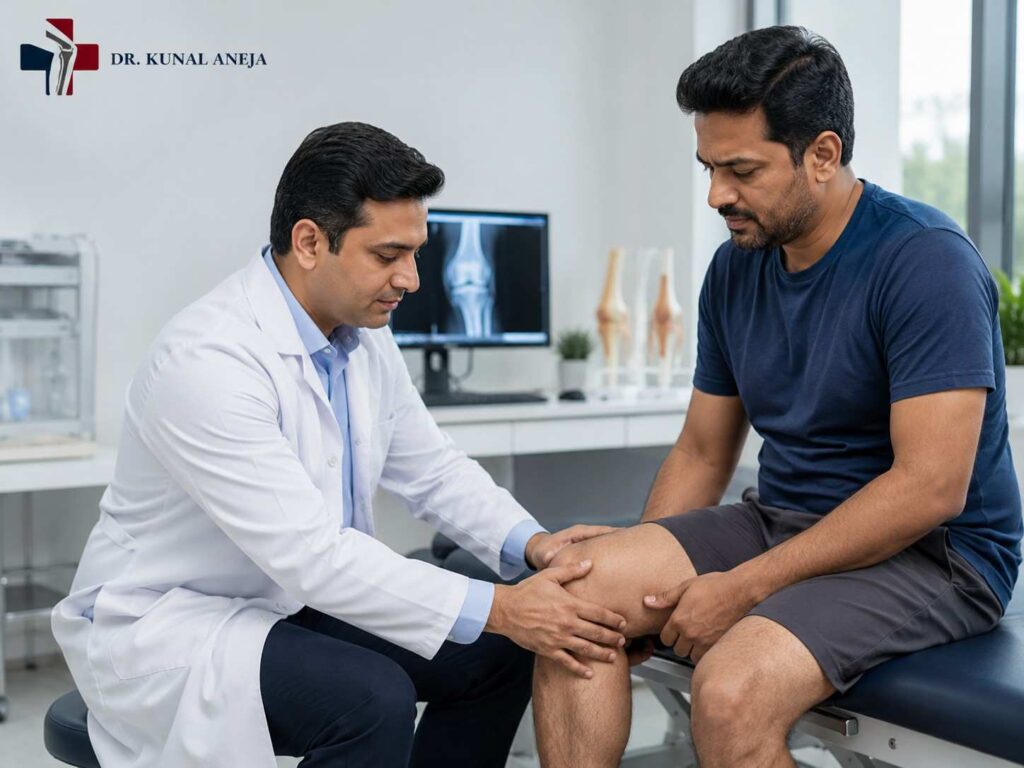
When is a rheumatologist the better choice?
Consider a rheumatologist when:
● Several joints are painful or swollen at the same time, often on both sides of the body
● Morning stiffness lasts longer than an hour
● Joint pain comes with fatigue, fever, skin rashes or eye problems
● Blood tests have already pointed toward an autoimmune or inflammatory condition
A rheumatologist manages the inflammation, and an orthopaedic surgeon steps in later if the joint itself needs repair or replacement. The two often work together.
What can an orthopaedic doctor in Delhi actually treat?
1. Joint Pain and Arthritis
Knee, hip and shoulder wear, managed through medication, injections and, when needed, joint replacement.
2. Fractures and Trauma
Setting, casting or fixing broken bones, from simple wrist fractures to complex trauma.
3. Sports and Ligament Injuries
ACL, meniscus and shoulder injuries, treated with minimally invasive arthroscopic technique where surgery is needed.
4. Hip and Knee Replacement
Robotic and computer-navigated replacement for advanced arthritis, covered on the hip replacement page.
5. Second Opinions
Patients told they need surgery can get an independent orthopaedic second opinion before deciding.
Why choose Dr. Kunal Aneja as your bone doctor?
Key advantages:
● Fellowship-level training across joint replacement, arthroscopy and trauma
● Practice in both Rohini and Shalimar Bagh, so you do not cross the city for follow-ups
● Honest sorting of what is orthopaedic and what needs another specialist
● Non-surgical options explored properly before surgery is suggested
A good bone doctor tells you when you do not need him. That honesty is worth more than any single procedure.
What are the warning signs that need a doctor quickly?
Do not wait if you notice:
● Swelling, redness and warmth in one joint along with fever
● Visible deformity or a limb that looks out of shape
● Inability to bear weight or move the joint at all
● Numbness or tingling spreading down an arm or leg
● Severe pain after an injury that does not ease with rest
These signs point to fracture, infection or nerve involvement, and each of them is better assessed the same day than the next week.
What happens at the first visit?
1. Conversation
You describe the pain, when it started and what makes it worse.
2. Examination
The joint is checked for movement, stability, swelling and tenderness.
3. Imaging if needed
An X-ray or MRI is advised only when it will change the decision.
4. Clear diagnosis
You are told what is wrong, in simple words, and what your options are.
5. A plan you agree with
Treatment, physiotherapy or a referral is decided together, with timelines.
Benefits of seeing the right specialist first
✔ Faster diagnosis, with fewer repeat consultations
✔ Fewer unnecessary scans and tests
✔ Early treatment before a minor problem becomes a major one
✔ Honest referral when another specialist is better placed
✔ Rehabilitation planned through physiotherapy and rehabilitation support alongside treatment
Starting with the right doctor is the cheapest way to get better.
Why Delhi patients trust Dr. Kunal Aneja
● Internationally recognised fellowships in arthroplasty and orthopaedic surgery
● Rohini and Shalimar Bagh practice for easy access across North and West Delhi
● A plain-spoken approach: diagnosis first, treatment second
● Direct WhatsApp access for quick questions before you book
● Thousands of orthopaedic procedures behind every recommendation
Patients keep coming back to a doctor who explains, not just prescribes.
Conclusion
A bone doctor in Delhi is an orthopaedic specialist, and the choice between orthopaedic and rheumatology care comes down to whether your pain is mechanical or inflammatory. Dr. Kunal Aneja assesses that carefully at the first visit and sends you to the right place even when it is not his.
For questions, email drkunalaneja@gmail.com or call (+91) 98112 11503. Follow patient updates on Instagram, YouTube and Facebook.
Book your consultation with Dr. Kunal Aneja here
FAQs
What is a bone doctor called?
A bone doctor is called an orthopaedic doctor or orthopaedic surgeon. They treat bones, joints, ligaments, tendons and related muscle problems.
Should I see an orthopaedic doctor or a rheumatologist for joint pain?
See an orthopaedic doctor for pain linked to movement, injury or joint wear. See a rheumatologist when several joints swell together, morning stiffness lasts over an hour, or the pain comes with fever or fatigue.
Do I need to see a general physician before a bone doctor?
No. You can go directly to an orthopaedic doctor for fractures, sports injuries and clear joint problems. A general physician helps when the cause is unclear or blood tests are needed first.
Is a bone doctor the same as a physiotherapist?
No. A bone doctor diagnoses and treats the condition, including surgery. A physiotherapist helps with rehabilitation and cannot diagnose fractures or dislocations.
Where can I consult a bone doctor in Rohini or Shalimar Bagh?
Dr. Kunal Aneja consults at Naveda Healthcare Centre and Saroj Medical Institute in Rohini, and at Max Super Specialty Hospital, Shalimar Bagh. You can call (+91) 98112 11503 to book.